


I have a significant issue with electric vehicles (EVs): since they hit the market, I’ve struggled to believe everything they promise. And even though Kia was determined to prove me wrong, my skepticism didn’t vanish easily. It’s not that I think they are some grand conspiracy by brands or by battery manufacturers, nor am I losing sleep over the possibility of a day when all the automobiles on the planet function without gasoline. I like cars. I like driving. I love the history, the racing, the speed, and the feeling a vehicle gives you. Few things do I enjoy as much as a powerful engine, an open highway, and the chance to discover what a machine can do when you push it a little further. I understand the advantages of electrification, but I also hold a recurring hypothesis: the range announced by manufacturers and the range you actually get in real life are two very different things.
With EVs, the anxiety isn’t just about getting stranded—something that can happen with gas cars too—it’s about getting stranded in the worst possible place. In almost any Mexican highway, you find a gas station every few kilometers. A charger? Well, that’s another story. There is nothing particularly romantic about spending your vacation waiting for a battery to work while you panic about what might happen if you run out of juice in the middle of the road.
That’s why, when I was asked to test the Kia EV3 2027, I decided I didn’t want to spend a few days driving around the city, plugging it in at night, and returning it with a perfectly reasonable—and useless—opinion. I wanted to put it to a real test: drive from my home in the Del Valle neighborhood to Acapulco via the Autopista del Sol without recharging the battery once.
The route has one advantage: it’s one of the most popular getaways for Mexico City residents. It also has one disadvantage: it’s not just a trip around the block. There is traffic, hills, motorcycles, drivers who seem to have never driven on a highway, construction projects that appear when least expected, and enough kilometers for you to start checking the battery indicator with the same anxiety as checking the time before an important date.
Kia has always seemed like a reliable, sensible brand that delivers on its promises—a brand for people who need a car that works, is well-made, doesn’t turn into a problem, and doesn’t require mortgaging a house to buy it. However, the last Kia that truly made me sigh was the Stinger, the sports sedan the brand eventually pulled from its Mexican portfolio. The Stinger had something I didn’t expect from Kia: lines so sporty they caught the eye even while parked. Since then, I haven’t remembered another model from the brand that sparked that kind of enthusiasm, though I do have favorites like the Sportage, the K3 hatchback, and the new Kia Seltos.
But the EV3 had a difficult mission: take me to Acapulco and, in the process, prove me wrong.
An Electric Car Connected to Mexico
Let’s start with an interesting fact: the Kia EV3 2027 is produced in the brand’s plant in Nuevo León, making it the first all-electric model manufactured by Kia in Mexico. This is no minor detail. Electrification is often told as a story of imported technology and pending infrastructure, but a locally made EV gives the conversation a different dimension—even if it doesn’t solve the challenges of highway charging on its own.
The adventure began with 97% battery in the Kia EV3 2027 and a question that wouldn’t leave my head: *Would it really be enough to reach Acapulco without recharging?*
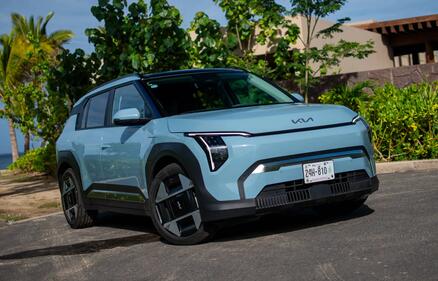
With excitement for this experiment, I left home with 97% charge. Not 100%. Real life rarely starts with perfect laboratory conditions. The first surprise arrived before I even turned it on. The EV3 doesn’t have that futuristic “appliance” look that some manufacturers consider essential to prove a car is electric. Its design is geometric, angular, and much more interesting than I expected. Kia calls it “Opposites United,” a philosophy that combines straight lines with fluid surfaces. The front end retains the “Tiger Face,” with Star Map LED daytime running lights. In the back, the robust silhouette and visually floating roof give it a presence that doesn’t go unnoticed.
I like that it has personality without looking like a design idea gone out of control. The retractable door handles help maintain its sleek figure, and the 19-inch wheels on the SXL version look great, though I must admit I don’t like the wheel designs of many electric SUVs. These, however, give it a more attractive stance than most in its category.
Because it is small—at least in industry terms—the electric platform allows for better interior space utilization. Without an internal combustion engine occupying the front or a traditional transmission cutting through the cabin, there is more room for people and their belongings. The result is an interior that feels spacious, with a comfortable driving position and plenty of room for five people to travel without the car feeling like the button of an ill-fitting shirt.
Range and Other Forms of Paranoia
The first 25 kilometers that separate my house from the Tlalpan toll booth served to familiarize myself with the car. When I reached Fonda 4 Vientos, a nearly mandatory stop on this route, the battery had dropped from 97% to 90%. A seven-percentage-point drop. It wasn’t exactly a catastrophe, but it wasn’t the type of data that would make me stop worrying. If the battery kept dropping at that rate, my adventure could end much sooner than planned.
I stopped for about an hour to eat *cecina* and other snacks. Until that moment, I had been driving with some caution. I didn’t know the EV3 well and had no intention of discovering its limits at the expense of my autonomy. If anything characterizes a skeptic, it’s the need for proof; if anything characterizes a *prudent* skeptic, it’s preferring to get that proof without challenging fate.
During that stop, I began to understand one of the peculiarities of driving an EV: the paddles behind the steering wheel don’t serve only to change gears, as in many automatic cars. In the EV3, they allow you to adjust the levels of regenerative braking. When you lift your foot off the accelerator, the motor can recover part of the motion’s energy and returns it to the battery. Depending on the selected level, the car decelerates with varying intensity.
It’s one of those things that seems like a technical detail until you start using it. Deceleration ceases to be just a way to lose speed and becomes an opportunity to recover energy. It doesn’t mean you can manufacture electricity out of thin air or that every brake is a miraculous recharge. But it does make you drive differently, anticipating traffic and making better use of the car’s movement.
I finished my meal, got back behind the wheel, and the real test began.
The EV3 SXL has a front electric motor delivering 201 horsepower and 209 lb-ft of torque. On paper, figures sufficient to move a SUV of this size with ease. In practice, the immediate response of the motor is one of the most evident advantages of an EV: you step on the accelerator, and the car responds without waiting for a transmission to find the right gear or for the engine to rev up.
Even so, the Autopista del Sol has its own plans. There are slow trucks that remind you that you aren’t the only one needing to reach the coast; there are construction zones that turn some stretches into an exercise in patience, and there are enough kilometers for you to start checking the battery indicator with the same anxiety as checking the time before an important date. But there is also that universal temptation to step a bit more on the accelerator when you find space to pass, but we all know that there are also agents strategically hidden to remind you that you are not in a racetrack.
But the EV3 has a responsiveness that is starting to enamor me. In one of those mountain stretches that open up, a German sports car with a gas engine appeared—the kind that, until recently, always seemed to have the advantage. The moment came to pass it, and I pressed the accelerator. The EV3’s instantaneous response allowed me to complete the maneuver easily. It’s evident that its driver wasn’t having a great day, but I’m going to enjoy the moment and count it as what it was: winning a battle against a sports car.
During all this time, I’ve been tempted to activate Sport mode. I know perfectly well that the EV3 isn’t a sports car, but the acceleration is addictive. Passing is a matter of honor, though common sense says otherwise. My priority hasn’t changed: reaching Acapulco with battery.
The SXL version has an 81.4 kWh battery, and Kia announces a range of up to 605 kilometers. In practice, the distance you can cover depends on speed, slopes, air conditioning, and, above all, how you drive. The more you demand from the car, the more energy it consumes.
Nevertheless, the size of the battery gives me enough margin to stop thinking about it for a while. I haven’t always managed to do it; there are stretches where I still look at the estimated range, as if staring at it intensely could magically prevent it from dropping.
Before this experiment, I had read a lot about the car. Among other things, I discovered that the EV3 won the World Car of the Year 2025 award, granted by an international jury of specialized journalists. Awards can be useful for identifying cars worth knowing, but none substitute the opinion you form by driving them.
I had agreed with Kia that, if necessary, I would stop at their dealership in Chilpancingo to recharge. My fear of not reaching Acapulco was real. Not having to do it was an advantage, but it was also intelligent to have a Plan B. Not reaching the destination is one thing, but not having plans to handle it is another.
I also learned that the brand has a new assistance function called KIA Connect, which allows you to press a button on the EV3 to trigger an emergency call if you run out of battery. A few minutes later, a vehicle equipped with an emergency battery will arrive to assist you. The charging time it promises is 100 kilometers in 10 minutes connected and works 24 hours a day, seven days a week, through a satellite geolocation system. And something very interesting: Mexico is the first country in the world in which Kia is implementing this program.
KIA Connect also offers a mobile charging service, an alternative for drivers who run out of battery far from a charger.
In fact, in Chilpancingo, the car still indicated around 180 kilometers of autonomy. I could have continued my way. I didn’t have to stop at the dealership, and I didn’t need to recharge to complete the journey. But the stop also reminds me of something that many people don’t take into account when purchasing an EV: autonomy matters, yes, but it also matters to know the infrastructure and understand how your vehicle works. It’s not just about the car being pretty, being well-priced, and trusting the brand because of its advertising campaigns.
After this stop, the road toward Acapulco ceases to feel like an exam. I still keep an eye on the indicator, but no longer with the same obsession. By then, I had dared to activate Sport mode and could enjoy the final stretch without worrying about recharging. The Kia has passed the test.
The Kia EV3 me showed something I didn’t expect: an electric car can be a “normal” car in the best sense of the word. It can be driven, it can be enjoyed, it can be reliable, and it doesn’t need to be a technological miracle to do so. It’s not that it’s perfect, nor that everyone must sell their gas cars tomorrow; there are still habits to consider, access to charging points, and the type of trips each person makes.
I wasn’t sure before this trip if an EV would ever make me sigh like the Stinger did. Now, I find myself thinking that my next car might just be electric.
After more than five hours of travel and without a single recharge, the Kia EV3 reached Acapulco with 18% of battery available. I left with 97%, did the entire trip without a single recharge, and still have enough energy to move around Acapulco. I let my bags go, looked at the sea, and realized that I have a new problem: I have to reconsider some of my beliefs about EVs.
I left the house with 97% of the battery and a question that wouldn’t leave my head: *Would it really be enough to reach Acapulco without recharging?*
The future doesn’t always make noise.