


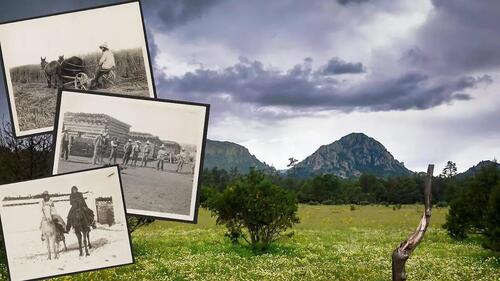
MADERA, Chihuahua — The history of the Chihuahua territory is etched into the soil of Babícora, a vast estate once considered a "state within a state." The property, which served as the centerpiece of a massive land empire, was defined by its vast plains, its resistance to the Mexican Revolution, and a brutal agrarian struggle that eventually ended in the dismantling of a grand latifundio.
The chronicler of the municipality of Madera, Manuel Vicente Guzmán, recently detailed the history of this property, which spanned territories across Madera, Temósachic, Gómez Farías, and Namiquipa. According to Guzmán, the name "Babícora" derives from indigenous languages of northern Mexico and translates to "enclosed waters" or "lagoon."
The Hearst Dynasty and the Birth of an Empire
The story began during the Porfiriato era when George Hearst—a powerful American senator and mining magnate—acquired more than 300,000 hectares of land through colonization laws. Following his death in 1891, the estate passed to his widow, Phoebe Apperson Hearst, who initially sought to utilize the plains for cultivating peanuts. The project failed due to the harsh climate and the property's distance from the railroad.
By 1900, Hearst's son, William Randolph Hearst, took control of the property and transformed it into a sprawling livestock empire through the Babícora Development Company. The hacienda specialized in raising Hereford cattle, horses, and sheep for export. Its operation included extensive fencing, private guards (known as "guardias blancas"), and a "tienda de raya" (company store), all of which symbolized the immense economic and territorial power accumulated by the American family.
Revolutionary Conflict and Agrarian Struggle
Babícora became a strategic target during the Mexican Revolution due to its abundant water sources and pastures. In 1915, Francisco Villa decreed the expropriation of the land. At that time, the revolutionary columns confiscated nearly the entire ranch. The Hearst company subsequently filed a claim for over $1.8 million in damages against the Mexican government.
Despite these setbacks, the property managed to survive for decades through "inafectability" declarations—legal protections that prevented the redistribution of land by arguing that the livestock activity was of public utility. These protections were renewed until 1942, even as the agrarian reform movement continued to press for the redistribution of the land.
Between 1919 and 1926, a first wave of land distribution took place in Madera, with 1,700 hectares being granted. However, the most significant transformation occurred during the Cárdenas administration, when nearly 125,000 hectares—approximately 30.7% of the total latifundio—were redistributed to peasants.
The Martyrdom of Socorro Rivera
One of the darkest chapters in the history of Babícora occurred on April 14, 1939. Socorro Rivera, an agrarian teacher sent to the region in 1936, led a protest to seize land in Peña Blanca. The hacienda's private guards, accompanied by Lieutenant Benjamín Tapia Niebla, arrived at the site, and a shootout ensued, resulting in Rivera's death. According to local history, his final words were: "Long live General Cárdenas! Death to foreign imperialism!".
Rivera's martyrdom became a symbolic flashpoint in the struggle for land, preceding the large-scale redistribution of 1942.
The Final Dismantling
The era of the great latifundio finally came to an end in 1954, during the administration of Adolfo Ruiz Cortines. The government revoked the inafectability protections and expropriated the remainder of the property to create "ejidos" (communal lands) and agricultural colonies. The agreement with the Hearst family included financial compensation and the preservation of three specific ranches.
For the people of Madera, the history of Babícora remains a powerful testament to the concentration of land ownership, the violence of the agrarian revolution, and the ultimate victory of the Mexican peasantry in securing the territory.