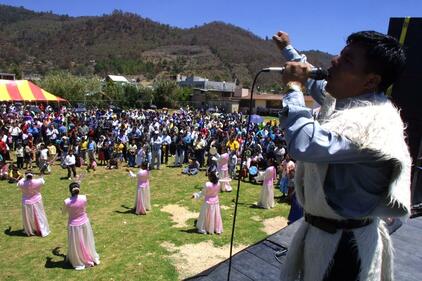
San Cristóbal de Las Casas, Chiapas, is distinguished by a wide variety of religious events with significant political and social implications. The region boasts an impressive density of Christian denominations, making it a unique epicenter of religious pluralism in Mexico.
In recent years, the activity of Zionist Christian churches has become increasingly noticeable. Facing the ongoing conflict in Gaza, these groups have opted to support Israel, mirroring a religious-political shift across Latin America. This movement has transformed the region into one of the few areas outside of Europe and the British Commonwealth that can be described as “”Israel-friendly.””
The religious landscape in Chiapas, particularly in the highlands, is dynamic. Even the Catholic Church—the region’s oldest institution—experienced significant shifts with the establishment of Liberation Theology under Bishop Samuel Ruiz García. This movement showed a marked preference for indigenous Maya peoples, particularly following the historic 1974 National Indigenous Congress in San Andrés Larráinzar. While the Zapatista Army of National Liberation (EZLN) maintains a non-religious identity, its civilian base and allied organizations in the jungle and highlands remain predominantly liberationist Catholic.
The region also hosts deeply rooted “”traditional”” or syncretic beliefs, some with pre-Hispanic elements, which were present long before the arrival of the Cross. San Cristóbal was a cosmopolitan hub even before its modern tourism boom. Today, it hosts Buddhist centers, oriental meditation retreats, a Sikh community, and a discreet Hasidic colony practicing Orthodox Judaism.
However, the social and religious profile of San Cristóbal was significantly altered by the mass exodus of families from neighboring San Juan Chamula in the 1980s. These families abandoned “”traditional Catholicism”” for evangelical and Pentecostal churches, facing violent persecution from the local political-religious authorities. These displaced families established numerous colonies, creating a massive presence of temples for various denominations—including Jehovah’s Witnesses and various Pentecostal sects—across the city and neighboring urban centers like Betania.
The historical context of this shift cannot be overlooked. In the 1990s, paramilitary groups were often integrated with evangelical followers, and their victims were frequently members of Zapatista bases or Catholic organizations, as seen in the 1997 Acteal massacre.
Against this backdrop, several denominations have pivoted toward a Christian Zionism similar to that seen in Central America, the Andean region, and the Amazon basin. In these areas, the continuous dissemination of Protestant churches has paved the way for explicit or tacit support for the State of Israel. These groups have become entry points for Israeli expansionism through religious practices that are increasingly less “”Christian”” and more akin to a secondary form of Judaism, fueled by US-based churches that have practiced religious colonialism for decades.
Israeli Prime Minister Benjamin Netanyahu previously noted during a 2019 visit to Brazil: “”We have no better friends in the world than the evangelical community, and the evangelical community has no better friend than the State of Israel.”” There are approximately 600 million believers globally, with 133 million in Latin America. In Brazil, there are nearly 50 million, and in the United States, over 90 million.
This association between non-Catholic Christian churches and Judaism is not new. However, the recent pro-Israel turn is a notable shift. Norman Lewis, the writer and chronicler who founded Survival International, warned years ago about the effects of these new missions. He noted that fundamentalist missionaries, recruited in the U.S. with “”impressive technical equipment and abundant funds””, announced the “”second coming of Jesus Christ”” and the end of the world as a means of “”saving”” true believers.
Over time, many of these followers have subordinated themselves to the official Judaism of the State of Israel, subsequently supporting its military actions in Palestine and Lebanon. Paradoxically, these evangelical groups—in their unconditional devotion to the “”mythical and real”” Israel—find little appreciation in Israel itself, where they are often treated as intruders and not few lack who spit in their path; they are not considered their equals.
A notable expression of this syncretism is the Church of God of the New Testament Judaism. This religious congregation expressly blends New Testament Christian faith with practices and elements of biblical Judaism, focusing on salvation, perfection, and sanctification through the study and practice of biblical Judaism. It shares the expectation of the Messiah, Yeshua Ha-Mashiaj, with Judaism. Led by Apostle Tito Galván Zafra, the group has a presence across the center and south of Mexico, with its groups—Hijos de Abraham, Damas de Ruth, Los Valientes de David, y Heme Aquí—notably active in the proximity of Israeli youth missions from the Israel Defense Forces (IDF) in Tuxtla Gutiérrez and San Cristóbal de Las Casas.