


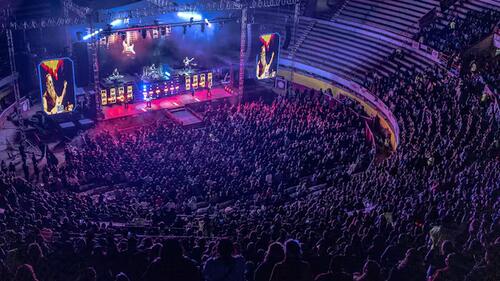
MEXICO CITY – The intersection of Mexico’s booming music industry and organized crime has reached a new level of sophistication. Recent investigations and U.S. government sanctions have exposed a massive laundering operation where high-profile concerts in Baja California serve as a front for “Los Mayos”—the faction of the Sinaloa Cartel led by the son of the notorious drug lord Ismael “El Mayo” Zambada.
At the heart of this scheme is the transition from the traditional “palenque” (outdoor concert) to high-end, mainstream entertainment. While the industry has long been susceptible to criminal influence, the current operation involves “In House Espectáculos” (Conciertos y Espectáculos Inhouse), a promotion firm sanctioned by the U.S. Department of the Treasury for laundering illicit proceeds from the sale of narcotics.
A High-Profile Front for Illicit Wealth
In House Espectáculos, owned by businessman Marco Antonio Moreno Gómez Santelices, has organized tours featuring some of the most recognizable names in Latin music, including Ricky Martin, Belinda, Roberto Carlos, and Molotov. By mixing legitimate ticket sales, concessions, and parking revenue with “dirty” money generated across the border, the cartel has successfully integrated illicit funds into the legitimate economy.
The scale of this opportunity is significant. In 2025, Mexico’s live music industry generated an economic impact of nearly $4.3 billion USD (68,990 million pesos), making it the third-largest live music market in the world, trailing only the United States and the United Kingdom.
The U.S. Office of Foreign Assets Control (OFAC) has identified Santelices as a key collaborator with “high-level money launderers” for the Sinaloa Cartel. The investigation also revealed troubling political ties: two of Santelices’ companies reportedly held contracts with the state government of Baja California to provide tactical uniforms for the state police and to manage tourism promotion.
A Pattern of Criminal Coercion
The use of concerts to “wash” drug money is not a new phenomenon in Mexico. The Cartel Jalisco Nueva Generación (CJNG) previously utilized a similar model through promoter Jesús Pérez Alvear (alias “Chucho Pérez”).
The CJNG’s model relied on violence to secure concessions at major venues like the Feria de San Marcos. In that era, the “narco-music” pipeline was so entrenched that even when the U.S. government issued warnings to artists to avoid performing at cartel-linked events, many continued to take the stage.
One of the most striking examples of this coercion involved singer Gerardo Ortiz. During a federal trial in 2025, Ortiz testified that he was “scared” and did not want to perform at a cartel-linked concert in Aguascalientes. However, his representatives pressured him into it, eventually arranging a high-priced private jet to transport him to the venue. Ortiz later received a percentage of the proceeds, while the cartel-linked promoter took a significant cut.
A Violent Reality for Promoters
The human cost of this “narco-music” business is often fatal for those caught in the middle. Both the previous CJNG promoter, Chucho Pérez, and the owner of Gallística del Noreste were assassinated in recent years. Pérez was reportedly murdered in a Mexico City restaurant in December 2024 while preparing to testify as a cooperating witness for the U.S. government.
For the artists, the risk is different but equally grave. While some have signed cooperation agreements to avoid prison—like Ortiz, who received probation in 2025—many remain caught between the demands of the cartels and the oversight of international law.
As the U.S. continues to tighten the noose on these entities via the “Kingpin Act,” the music industry remains a primary battlefield for the Sinaloa Cartel, where the roar of the crowd provides a convenient mask for the movement of illicit wealth.