


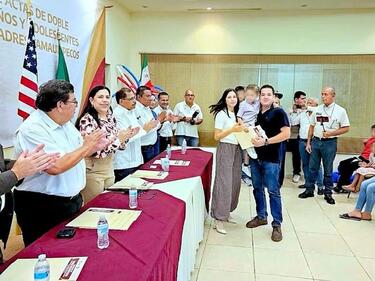
EL MANTE, MEXICO — Over 20 children and adolescents born in the United States have officially received dual nationality documentation in Tamaulipas, a move that provides them with legal recognition in Mexico without requiring them to relinquish their American citizenship.
The initiative, facilitated by the Tamaulipas Institute for Migrants (ITM), is part of a broader support program designed to assist migrant families who have returned to Mexico. By obtaining these certificates, the minors can now legally prove their Mexican nationality, which is a prerequisite for accessing essential public services, including healthcare, education, and various social programs or scholarships.
The distribution of the documents, which took place in El Mante, underscores a growing demographic trend in the state. An increasing number of Mexican families who migrated to the United States are returning to the region, bringing children who were born on U.S. soil but who are now developing their lives and identities in Mexico.
Juan José Rodríguez Alvarado, Director General of the Tamaulipas Institute for Migrants, emphasized that the primary goal of the program is to provide legal certainty for these children.
“There are children who were born in the United States, but today their lives are here, in Tamaulipas,” Rodríguez Alvarado said. “Dual nationality allows them to have the legal recognition they need to exercise their rights in Mexico, without losing the links and rights they have in the United States.”
The ceremony in El Mante was attended by several local authorities, including the municipal president, Martha Patricia Chío de la Garza, and local deputy Alberto Moctezuma Castillo. The event was part of a coordinated effort between different levels of government to simplify the documentation process for families with migration ties.
By streamlining these administrative procedures, the state aims to ensure that “second-generation” migrants can be fully integrated into their local communities, ensuring that their legal status does not become a barrier to their social and economic development.