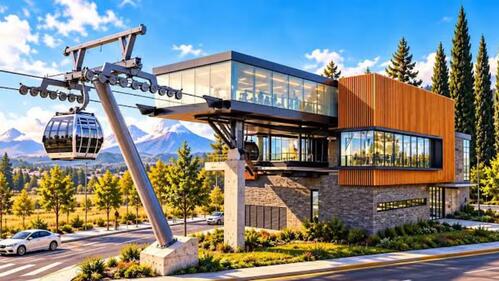
The state of Puebla is moving forward with the construction of its Cablebús, a cable car transport project designed to revolutionize mobility in the Mexican city. According to official government information, the system will span 14.58 kilometers and feature four lines, nine stations, and 94 towers.
Construction is being rolled out in phases, and on October 20, 2026, authorities announced the commencement of work on three key stations. The primary objective of the project is to slash travel times from 100 minutes down to just 44 minutes, based on official estimates.
Route Scope and Connectivity
The Cable Transport System (STC) encompasses a 14.58-kilometer route distributed across four lines. These lines will connect various residential areas, recreational spaces, and economic hubs in the capital of Puebla. The project includes 94 towers and nine stations, as detailed in the government’s October 11, 2026, announcement.
The planned routes will connect:
- Mayorazgo with Parque Juárez
- Parque Juárez with Xonaca
- Xonaca with Cerro de Amalucan
- Parque Biblioteca with the Mario Vázquez Raña Sports Complex
The system is part of a broader mobility strategy aimed at improving connectivity across different points in the Puebla Metropolitan Area.
Construction Status and Logistics
On October 20, 2026, the state government announced the start of construction for the Parque Juárez, Parque Ecológico, and Amalucan stations, which are three of the nine planned for the project.
Officials also reported supervising the manufacturing of components in Austria and Switzerland, including motors, cabins, towers, and electromechanical equipment. The first shipments for Line 4 were expected to arrive at the Port of Veracruz between October 25 and 31, before being transported to Puebla for final inspection.
Estimated Time Savings and Integration
A core goal of the Cablebús is to reduce commute times by more than half. The government plans to integrate the system into the Sistema Integral de Movilidad (SIM Puebla). The proposal includes a single physical or digital card that will allow users to access the Cablebús, the Red Urbana de Transporte Articulado (RUTA), and the public bicycle network, with a differentiated fare structure. The actual reduction in travel time will depend on real-world operational conditions once the system is fully functional.
Timeline for Completion
The system still needs to complete multiple construction phases, equipment installation, testing, and certification. During an informational assembly on September 19, the state government indicated that construction is estimated to take two years, followed by one year of testing, certification, and commissioning.
The project aims to benefit 774,000 people within a metropolitan area of approximately 1.8 million residents. Furthermore, it identifies 54,632 individuals living in the project’s direct area of influence.