


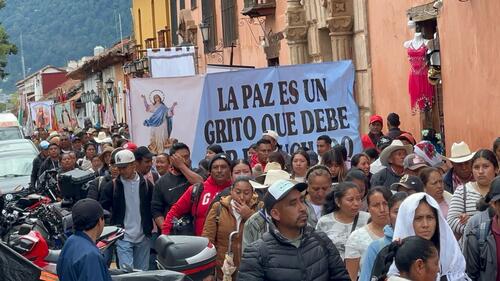
SAN CRISTÓBAL DE LAS CASAS, Mexico – Indigenous Catholic parishioners from seven regions of Chiapas took to the streets on Monday, October 19, to protest the ongoing violence and organized crime in the region. The march, held two years after the murder of Tseltalan priest Father Marcelo Pérez Pérez, served as a public denunciation of the insecurity plaguing their communities.
The demonstration culminated in a public statement issued by the Believing People of the Diocese of San Cristóbal. The declaration highlighted a disturbing trend of “recruitment of youth” by organized crime groups for drug trafficking and spotting, as well as pervasive drug use among children. The group called upon civil society, the media, and all three levels of government to intervene in these systemic issues.
The protesters also denounced a wide range of abuses, including the sale of alcohol and drugs, threats against whistleblowers, frequent gunfire in local neighborhoods, feminicides, forced disappearances, and extortion on highways. They specifically demanded an end to the “imprisonment and assassinations” of church servants and human rights defenders, calling on the Office of the Attorney General (FGR) to identify the intellectual authors of Father Pérez Pérez’s murder.
A Legal Process in Motion
Despite the ongoing violence, the judicial process regarding Father Pérez Pérez’s murder has shown some progress. Two years after the priest was shot in the Cuxtitali neighborhood on October 20, 2024, two individuals are currently in the legal system.
Edgar Rolando Mares Banda was sentenced to 20 years in prison, identified as one of the material executors of the crime. The second case involves Héctor “N,” identified as “El Chesman,” a suspected leader of the Los Motonetos group. The case is currently in the intermediate stage, where evidence for the oral trial is being determined.
Father José Filiberto Velázquez Florencio, director of the Center for the Rights of Victims of Violence, emphasized that while these legal steps are significant, they do not constitute a full resolution. “The progress of the judicial proceedings is an important aspect, but it cannot be confused with the full clarification of the facts,” Velázquez Florencio stated. He stressed that the investigation must remain linked to the broader context of violence in the state and the threats faced by those who defend human rights.
A History of Violence and Resistance
The march served as a somber reminder of the broader history of violence in Chiapas. The organization linked the current situation to several other tragedies, including the 1997 Acteal massacre, where 45 Tseltal people were killed, and the 2021 murder of Simón Pedro Pérez López, an activist and former president of the Las Abejas group.
The demonstration was marked by a traditional Mayan ceremony, where participants carried banners of white cloth painted with the word “PAZ” (Peace) and banners of patron saints. The ceremony, led by the Bishop of San Cristóbal de Las Casas, Rodrigo Aguilar Martínez, included an altar of flowers and candles dedicated to Father Marcelo Pérez Pérez, with the message: “Marcelo lives, the struggle continues.”
The protesters concluded with a plea for peace, demanding: “No more intimidations and assassinations of priests, church servants, and defenders of life!” and “Stop the forced displacement!”