


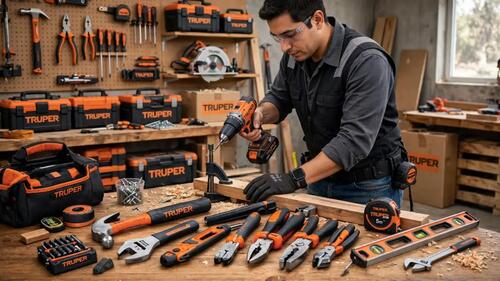
MEXICO CITY — The history of the Truper brand is a quintessential story of the “Mexican Dream.” It began not in a boardroom, but in the bustling street markets of Mexico City with a 19-year-old Ukrainian immigrant who laid the foundations for an industrial empire that now exports to over 70 countries.
From a workshop where Isai Jusidman made mason’s spoons, Grupo Truper passed to operate a multinational industrial powerhouse.
The Ukrainian Roots of a Mexican Icon
In 1923, Isai Jusidman arrived in Mexico City from Ukraine, a country reeling from the aftermath of the Russian Revolution. Coming from a family of hardware merchants, Jusidman quickly adopted the trade as his livelihood in his new home.
His initial steps were humble, selling tools in the capital’s informal markets. Eventually, he opened a small hardware store (tlapalería) on Guerrero Street and later established a workshop in the Doctores neighborhood. It was there that he began manufacturing his own products on a limited scale, producing items like mason’s spoons, plumb bobs, and hammers sold under the brand name Mercur.
Jusidman’s death in 1961, when he was just 57, marked a turning point for the business. While he had built the groundwork, the operation remained modest. However, his son, Daniel, took the helm at the age of 28 and made a pivotal decision: he closed the retail store to concentrate resources on the workshop. Daniel pivoted from merely selling tools to mass manufacturing—a move that required significant investment and the capacity to compete in a market with few production alternatives.
Technological Alliances and the Birth of the Brand
In the late 1960s, Daniel found a strategic ally in the American company True Temper. This partnership allowed the business to incorporate advanced technology and knowledge to manufacture a wider range of tools in Mexico, such as shovels, picks, and wheelbarrows—staples of the construction industry.
The alliance concluded in the mid-1970s, but it left a permanent mark. A publicity agency proposed the name “Truper”—a contraction of “True Temper”—which was accepted by the partners and officially registered as a brand. From that point on, the company continued its growth under its current name, independent of the American firm.
Lessons from Failed Expansion
The 1980s saw an attempt to bring Truper to the United States through a partnership that eventually birthed “Truper USA.” However, the expansion failed to yield the expected results, highlighting the limitations of that specific venture. The experience forced the company to refocus its efforts on markets where it held a competitive advantage: Mexico and Latin America.
This shift coincided with the liberalization of the Mexican economy in the 1990s. Truper adapted by expanding its catalog to include imported tools and diversifying into plumbing, electrical materials, and locksmithing. Instead of persisting in a failed international expansion, the company chose to strengthen its regional dominance and diversify its product portfolio.
The End of the Founder Era
After two generations of family leadership, Daniel Jusidman sold Truper in 2006 to a group of private investors with experience in the hardware sector. At 70 years old, he decided to retire and pursue personal projects.
At the time of the sale, Truper was a significant regional player with approximately 3,500 employees. The sale marked the end of the founder’s family era, transitioning the company into the hands of private equity, while the brand continued its evolution into what is now Grupo Truper.
Grupo Truper Today: A Global Industrial Power
From a workshop where Isai Jusidman made mason’s spoons to a multinational industrial powerhouse, Grupo Truper now operates more than 20 industrial plants and employs approximately 30,000 people.
The company’s business model combines manufacturing, importing, and distribution of hardware products. Its catalog boasts over 15,000 items across seven brands: Truper, Pretul, Foset, Volteck, Fiero, Hermex, and Klintek, which cover categories such as manual tools, plumbing, electrical materials, locksmithing, and cleaning.
Its infrastructure includes 16 distribution centers in Mexico, a network of over 25,000 clients, and 1,500 sales representatives. In terms of quality, the company operates a specialized center spanning over 9,000 square meters, staffed by more than 750 engineers who conduct over 250,000 tests annually. Furthermore, more than half of the company’s production is destined for international markets.
The figures illustrate the scale achieved more than a century after Isai Jusidman began selling tools in Mexico City. While corporate data does not specify exact profits or revenue, the industrial capacity and commercial reach of Grupo Truper stand as a testament to a century of manufacturing evolution.