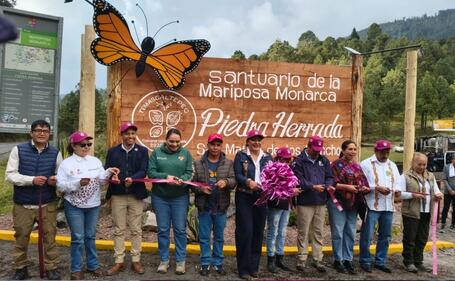
MEXICO CITY – The annual migration of the monarch butterfly has reached its destination as the sanctuaries in Michoacán and the State of Mexico officially opened this weekend. The sites are now accessible to the public for the 2026-2027 hibernation season, remaining open until March 31, 2027, from 8:00 a.m. to 5:00 p.m.
The inauguration was held at the Piedra Herrada sanctuary in Temascaltepec and was organized by the Secretariat of the Environment and Natural Resources (Semarnat), the National Commission of Protected Natural Areas (Conanp), and the government of the State of Mexico.
According to an official statement from Conanp, the opening includes several key sites across both states:
- Michoacán: El Rosario (Ocampo municipality), Senguio (Senguio municipality), and Sierra Chincua (Angangueo).
- State of Mexico: Piedra Herrada (San Mateo Almomoloa, Temascaltepec municipality) and La Mesa (San José del Rincón).
An Extraordinary 4,000-Kilometer Journey
Every autumn, millions of monarch butterflies embark on an incredible migratory odyssey, traveling more than 4,000 kilometers from southern Canada and the northern and central regions of the United States to the mountains of central Mexico.
Marco Antonio Castro, regional director for the Center and Neovolcanic Axis of Conanp, underscored the international significance of the phenomenon. He noted that the migration unites three nations and necessitates a shared vision and “decisive actions.” To this end, the Mexican government continues to promote management programs and the Monarch Butterfly Conservation Action Plan in close coordination with its neighbors, the United States and Canada.
Significant Growth in Colony Size
The news of the opening comes on the heels of encouraging conservation data. Alhely R. Arronis, head of the State of Mexico’s environmental secretariat, reported that during the 2025-2026 hibernation season, monarch colonies occupied 2.93 hectares of land—a remarkable 64% increase compared to the 1.79 hectares recorded in the previous cycle.
“The conservation of this species depends on the collective effort of everyone,” Arronis stated, emphasizing that protecting the butterfly is a shared responsibility involving governments, institutions, civil society organizations, local communities, and landowners.
The official visit included a field inspection of the Piedra Herrada colony. Officials toured the oyamel and pine forests to verify the location, extent, and distribution of the butterflies, while simultaneously assessing the overall health of the winter habitat and current conservation conditions.