


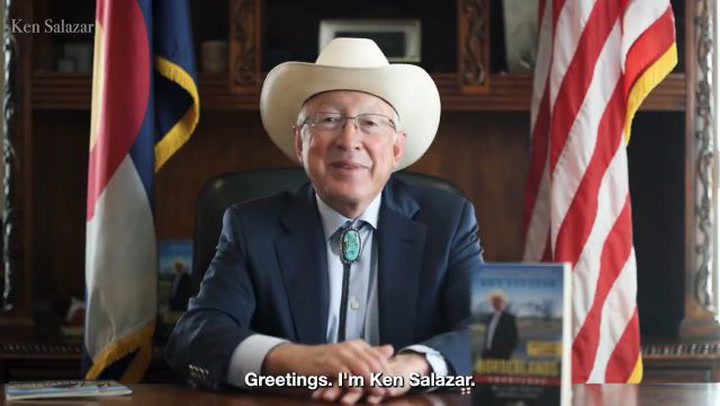
MEXICO CITY — Former U.S. Ambassador Ken Salazar has announced a visit to Mexico City on October 14 to promote his upcoming memoir, a move that arrives amidst a sharpening diplomatic rift between Washington and the Mexican government. The visit reignites a fierce dispute over the narrative of the 2024 transfer of drug lord Ismael “El Mayo” Zambada—an operation that former President Andrés Manuel López Obrador has characterized as a clandestine pact with the sons of “El Chapo.”
The visit comes in the wake of the release of López Obrador’s latest book, in which the former president leveled scathing accusations against U.S. intelligence agencies. He alleged that Washington entered into “clandestine and extraterritorial” agreements with the family of “El Chapo” to facilitate Zambada’s transfer to the United States, labeling the operation as “extrajudicial” and an “interventionist” violation of Mexican sovereignty.
While López Obrador has historically used his platform to cast the U.S. as an overreaching security agent, Ken Salazar’s upcoming appearance seeks to offer a different perspective. In a series of social media posts, Salazar emphasized his identity as both an American and a Mexican-American, speaking of a “broken” border and a migration system in dire need of repair. His stated goal is to promote a vision of North America as a “family of the continent,” focusing on the economic and democratic future of the 50 million Mexican-Americans in the U.S.
The diplomatic tightrope is currently being walked by President Claudia Sheinbaum. During a recent press conference, Sheinbaum was asked to address the allegations in López Obrador’s book and the conduct of current Ambassador Ronald Johnson. While she acknowledged the former president’s interpretation of the Zambada case as “very interesting,” she maintained a posture of diplomatic restraint.
“I must preserve diplomatic ties,” Sheinbaum stated, noting that while she respects the principles of national sovereignty, she must exercise caution in her official capacity. She underscored that while López Obrador is free to speak as a private citizen, her administration’s priority is maintaining a functional relationship with Washington.
The friction between the two narratives is already visible in the facts presented by both sides. Salazar has publicly denied that any U.S. agencies participated in the Zambada operation, a claim that has been complicated by later reports of FBI involvement. Conversely, López Obrador has used the case to argue that the U.S. ignores Mexican authority, a stance that has led to a cooling of relations with the U.S. diplomatic corps.
Salazar’s visit on October 14 is expected to be a significant public forum for these competing histories, as he seeks to frame the border not as a site of intervention, but as a shared responsibility for a unified continental future.