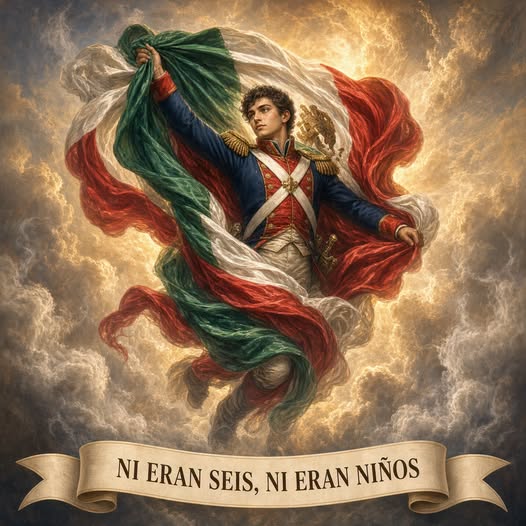
MEXICO CITY — Every September 13, Mexico commemorates the defense of Chapultepec Castle, a day defined by the evocative legend of six children who died defending the fortress, one of whom supposedly leaped to his death wrapped in the Mexican flag. However, historical scrutiny reveals a narrative that is significantly more complex—and arguably more heroic—than the popular myth suggests.
The “six children” celebrated in national lore are a historical oversimplification. During the 1847 siege against U.S. forces, the defense was comprised of approximately 50 cadets from the Military College, supported by hundreds of soldiers. The six figures remembered today were simply the individuals whose deaths were officially recorded. Furthermore, the term “children” is a misnomer; these were young men between the ages of 14 and 20. For example, Juan de la Barrera was a 19-year-old lieutenant.
The most iconic image of the battle—Juan Escutia jumping with the flag—lacks any verifiable evidence. Most historians believe that Escutia did not perform a deliberate leap but rather fell during a gunfight while attempting to flee. In reality, the individual who actually wrapped himself in the flag to save it was Captain Margarito Zuazo, a figure who has faded from public memory because his actions lacked the poetic appeal of the Escutia legend.
The true heroism of the event lies in the soldiers’ conscious choice to defy direct orders. General Nicolás Bravo had commanded the cadets to evacuate and seek safety; instead, they chose to remain and fight to the death to defend their school while Mexico was losing vast territories to the United States.
The construction of this myth serves a specific national purpose. Following the devastating loss of half the country’s territory to the U.S., a nation in mourning required a narrative of profound pride. While a military defeat provides little inspiration, a “beautiful death” offers the necessary framework to sustain national identity. Nations, it seems, are sustained by the stories they choose to believe.