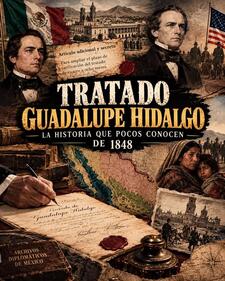
MEXICO CITY – While most people recognize the Treaty of Guadalupe Hidalgo primarily for the massive loss of territory and the payment of $15 million, a deeper, more complex narrative exists behind the signatures. A series of clandestine negotiations, secret articles, and diplomatic maneuvers shaped a legacy that continues to impact land rights and regional identity today.
1847: The Negotiator Who Defied Washington
As the United States military occupied Mexico City, Nicholas Philip Trist was tasked with negotiating peace with Mexican representatives Luis Gonzaga Cuevas, Bernardo Couto, and Miguel Atristáin. However, in October 1847, President James K. Polk ordered Trist to return to the United States.
Trist disobeyed.
Convinced that an agreement was still achievable, he remained in Mexico and continued negotiations without authorization. His decision was extraordinary: an American representative was negotiating a treaty of immense territorial consequences after being ordered to abandon his mission. He eventually succeeded in securing the signature on February 2, 1848.
The Secret Article of February 2
Accompanying the main treaty was a supplementary secret article. It did not propose a clandestine sale of land or new economic concessions; rather, its purpose was to extend the deadline for exchanging ratifications from four to eight months.
Mexico was facing a profound political crisis, its capital was occupied, and it needed time to secure approval from its own institutions for such a controversial agreement. However, once the document reached the U.S. Senate, the secret article was stripped away. Its existence remains a matter of historical record in official diplomatic archives.
March 1848: The Vanishing Article
The U.S. Senate did not simply approve the treaty; it also modified several critical provisions. One of the most significant actions was the complete removal of “Article X.”
This specific article addressed land concessions granted by Mexican authorities within the ceded territories. For many families, ranchers, and communities, these concessions represented property inherited over generations. Its removal sparked immediate concern among Mexican negotiators. While Article VIII still provided general property guarantees, the specific protections for these concessions vanished. Decades later, residents of New Mexico and California would face protracted legal battles to prove the validity of their land titles.
May 26, 1848: The Protocol of Querétaro
In a lesser-known diplomatic episode, Mexican Minister Luis de la Rosa met with Nathan Clifford and Ambrose H. Sevier, representatives of the United States, in Querétaro. Mexico sought clarification on the changes introduced by Washington.
The three parties signed the “Protocol of Querétaro.” In that document, U.S. representatives explained that the removal of Article X was not intended as an annulment of the legitimate Mexican land concessions. They also provided clarifications on the civil, political, and religious guarantees for the inhabitants of the ceded territories.
However, the U.S. government later maintained that its representatives were not authorized to establish additional commitments through that protocol. This led to long-standing diplomatic disputes over the scope of those protections.
Forgotten Files and Captured Archives
Historical records from 1848 reveal another overlooked detail. Documents from the Mexican Historical Diplomatic Archive show a proposal to request the return of Republic archives held by U.S. forces. This highlights a concern rarely mentioned in popular history: Mexico sought not only to recover occupied buildings and land but also official documents.
The archives confirm that the request was made. While the exact volume of documents recovered remains uncertain, the record proves that the preservation of official history was a key diplomatic goal.
The Prisoners of War
Article IV contained a provision that often goes unnoticed. Beyond the return of prisoners of war, it mandated the liberation of Mexicans held captive by indigenous groups within the new U.S. borders. The U.S. government was obligated to seek their rescue and return them.
This inclusion demonstrates that the plight of captives and cross-border conflicts were significant enough diplomatic concerns to be codified in the peace agreement.
The Frontier Obligations and the Mesilla Treaty
Another commitment affected directly Chihuahua, Sonora, and other frontier regions. Article XI established U.S. obligations to prevent certain indigenous incursions from their territory into Mexico. It also prohibited their inhabitants from purchasing captives or goods obtained during such raids.
However, these conflicts persisted. Mexico continued to protest cross-border incursions until the Treaty of Mesilla (1853–1854) finally eliminated those specific obligations.
Customs and Occupation Revenue
The treaty also regulated an economic detail that is rarely mentioned. During the occupation, U.S. forces administered customs in Mexican ports. Article III established provisions for returning these ports to national authorities and delivering accounts of rights collected during the ratification period.
It was not merely a military withdrawal; it was an administrative hand-off of infrastructure and revenue.
The Border That Still Had to Be Measured
Although the treaty described the new border, it was not materially delimited on the day of the signing. Article V ordered the appointment of commissioners and surveyors from both nations to conduct measurements, create maps, and establish border markers.
These tasks required subsequent expeditions and technical agreements, leading to further controversies that would influence future territorial negotiations.
Mexico had lost a vast expanse of territory, but behind that loss remained suppressed articles, disputed diplomatic documents, land claims, and frontier obligations. The borders changed in 1848, but the disputes left behind by the treaty survived for generations.