


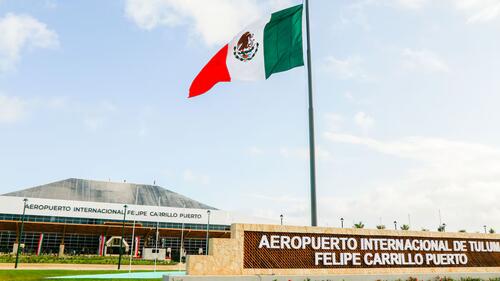
MEXICO CITY — American Airlines, the first international carrier to operate out of Tulum’s airport, will significantly reduce its flight offerings from the destination as part of a broader seat reduction across the military-operated terminal.
The U.S. carrier confirmed to El Financiero that it will discontinue its route between Los Angeles and Tulum—one of the first connections established when the airport opened in March 2024.
“As part of specific actions to strengthen the airline, we will suspend our Tulum (TQO) – Miami (MIA) service starting January 5, 2027. We will continue operating service from our hub in Dallas-Fort Worth (DFW),” the airline stated.
The reduction comes at a critical time, as U.S. tourism remains the primary driver for the region. The partial withdrawal of American Airlines is expected to put further pressure on declining international tourist arrivals to Mexico.
American Airlines initially launched with a strong presence, offering four daily flights, including two from Dallas, one from Charlotte, and one from Los Angeles. By January, only the Dallas-Fort Worth connection will remain operational, reduced to a single daily flight. Furthermore, the airline has modified its aircraft fleet for the remaining route, deploying an Embraer 175 from a subsidiary group. This marks a shift from the Boeing 737-800 aircraft, which could carry 172 passengers, to a configuration with a maximum capacity of only 78 seats.
Why is Tulum’s Airport Losing Routes?
Despite initial excitement surrounding the construction of Tulum’s airport—which was marketed as a quieter, more accessible alternative to Cancun—the facility has seen a sharp decline in traffic. While it initially attracted a million passengers within its first year of operation with flights from the U.S., Europe, Colombia, Canada, Panama, and major Mexican hubs, the numbers are now plummeting.
Industry analysts point to several factors for this decline:
- Removal of Incentives: Unlike typical commercial airports, the military-run Grupo Mundo Maya administration removed the standard three-year incentives usually offered to airlines to stimulate new routes. Airlines began pulling back in 2025 following the elimination of these industry-standard discounts.
- Tourism Deterioration: A massive influx of sargassum seaweed and perceived poor management of the destination have caused travelers to begin abandoning Tulum.
- Reduced Traffic: The jungle-enclaved airport currently averages only ten daily flights, a drop of nearly three-quarters from its peak volume a few years ago.
Currently, the remaining daily flights are serviced by national carriers Mexicana (a military-linked company) and Viva Aerobus. Viva Aerobus noted to El Financiero that it will continue its operations, occasionally offering more than one flight daily from the Felipe Ángeles International Airport (AIFA)—another military-run facility—to Tulum.