


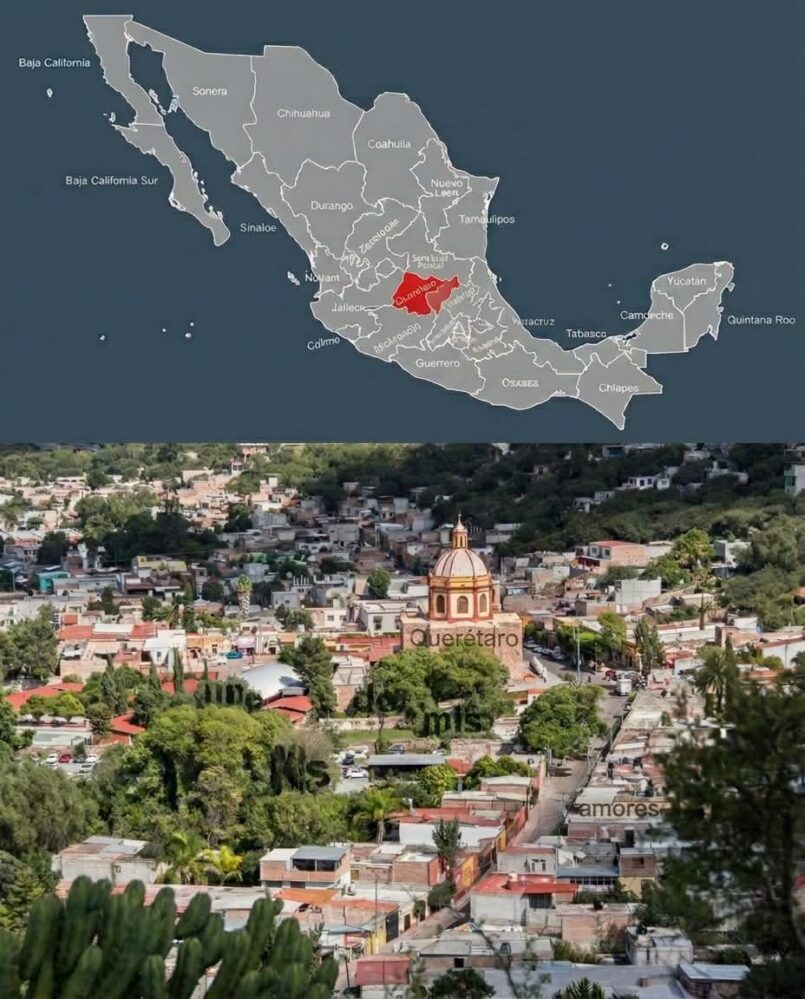
QUERÉTARO, MEXICO — Every time a resident walks beneath the arches of the famous Acueducto de Querétaro, few realize that the water once flowed through it originated in a small town a few kilometers to the east. Tucked away in a valley surrounded by natural springs, the town of La Cañada holds a history that is inextricably linked to the birth of the city of Querétaro.
For centuries, La Cañada served as the lifeline for the region. Long before Querétaro became a major urban center, the valley was already a site of historical significance. According to local commemorative plaques, it was here that the Otomí leader Conni—later known as Hernando de Tapia—returned with five hundred men. From this valley, the expedition set out to conquer and found what would eventually become the cities of Querétaro, Los Apaseos, and San Miguel el Grande.
A Sacred Beginning
Tradition holds that in April 1531, the first mass in the history of Querétaro was celebrated in La Cañada. It was in a small temple—still standing today and affectionately known as La Iglesia Chiquita—that the Franciscan friar Jacobo Daciano baptized the Otomí Conín, renaming him Hernando de Tapia.
The tiny chapel remains a hidden treasure of the region. Inside, a large block of pink quarry stone is preserved as the traditional site of the baptism. For nearly five centuries, this stone has stood as a witness to the transformation of the region’s destiny. Today, the site serves as a sanctuary for the Virgin of Guadalupe every December 12th.
The Springs That Sustained a City
As the centuries passed, La Cañada evolved into a vital water source. In 1615, Viceroy Diego Fernández de Córdova granted the ownership of the “El Pinito” spring to the inhabitants of La Cañada. From this point forward, the water was channeled to the Acueducto to supply the growing city of Querétaro.
However, the most famous chapter of this history involves a man named Juan Antonio de Urrutia y Arana, the Marquis of the Villa del Villar del Águila. In 1721, five Capuchin nuns sought his help to secure clean water, and he utilized the “Ojo de Agua del Capulín” spring. When the initial flow proved insufficient, he ordered the excavation of additional sources. By 1738, he completed the construction of a reservoir to store the spring water.
The Marquis, who had arrived in Querétaro with a fortune and spent it leaving a lasting mark on the city, eventually became the region’s greatest benefactor. In recognition of his contributions, the municipality eventually adopted his title as its own.
From Bathhouses to Industrial Hubs
La Cañada’s history is also one of social life. In 1736, military leader José de Escandón purchased lands to build public baths. These became so popular that by the mid-19th century, they were locally known as “El Piojito.”
A curious condition existed for these baths: residents could bathe for free, provided they contributed one peso every Monday to the local priest. This money was intended to pay for a mass for the soul of Escandón and the town’s indigenous people. It was a sacred pact between water, faith, and community that persisted for generations.
By the late 19th century, the town saw the arrival of progress in the form of the first train to the state capital in 1882. During the Mexican Revolution, the town also hosted notable figures; in 1916, Venustiano Carranza stayed in the town during the first days of the Constituent Congress. Later, thepresidential elect Álvaro Obregón stayed in a local home for four days before his assassination. Today, that house serves as the town’s Cultural House.
A Modern Municipality
In 1941, La Cañada officially became its own municipality, separating from Querétaro. However, in 1948, a law was passed to restore the town’s original name, La Cañada, while naming the municipality “El Marqués” in honor of the Marquis who had provided the water that gave the city life.
Today, El Marqués has transformed from a valley of springs into a powerhouse of industrial growth. It is now the third most populated municipality in the state, with a population that nearly doubled between 2010 and 2020. It serves as a primary industrial pole for the region, hosting international trade centers, manufacturing hubs, and logistics parks.
From the springs that fed a city to the factories that drive a modern economy, El Marqués remains a testament to a legacy of transformation—where the water of the past continues to flow through the progress of the present.